





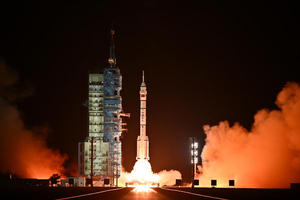

China launched its Shenzhou-24 spacecraft on Wednesday, November 25, 2026, carrying Pakistani astronaut Muhammad Zeeshan Ali alongside two Chinese astronauts to the Tiangong space station. The mission marks a historic milestone for both countries, with Ali becoming the first Pakistani astronaut to travel into space and the first foreign crew member aboard China’s independently operated orbital space station.
The spacecraft lifted off aboard a Long March 2F rocket from the Jiuquan Satellite Launch Center in northwestern China at 12:18 a.m. GMT on Wednesday, corresponding to 7:18 p.m. EST on November 24. It successfully docked with the Tiangong space station several hours later.
Ali, a 40-year-old Pakistan Air Force pilot and payload specialist, was accompanied by Chinese astronauts Tang Hongbo, 51, and Wu Yi, 39. Tang also made history by becoming the first astronaut to visit the Tiangong space station three times.
Ali is scheduled to spend approximately one week aboard the orbital laboratory before returning to Earth aboard the Shenzhou-23 spacecraft alongside two members of its existing crew. Tang and Wu will remain aboard Tiangong for a standard six-month mission, while Shenzhou-23 commander Zhu Yangzhu will continue his stay to complete a full year in orbit, marking another first for China’s human spaceflight programme.
The Shenzhou-24 mission is expected to conduct more than 90 scientific experiments and technological tests. Ali’s research will focus on joint Chinese-Pakistani projects in biotechnology, agriculture and advanced materials. These include cultivating photosynthetic cyanobacteria and microalgae in microgravity, examining the effects of spaceflight on quinoa seeds and studying self-healing carbon fibre composites that could have applications in aerospace engineering.
The historic mission follows a bilateral space cooperation agreement signed in February 2025 between China’s Manned Space Agency and Pakistan’s Space and Upper Atmosphere Research Commission (SUPARCO). Established in 1961, SUPARCO is among Asia’s oldest national space agencies, although Pakistan’s space programme has historically focused on satellite development, remote sensing and telecommunications rather than human spaceflight.
China and Pakistan have maintained extensive space cooperation for decades. Pakistan’s first satellite, Badr-1, was launched aboard a Chinese rocket in 1990. In May 2024, Pakistan’s ICUBE-Q lunar satellite travelled aboard China’s Chang’e-6 mission, marking another milestone in the country’s space exploration programme. Pakistan is also expected to contribute a lunar rover to China’s planned Chang’e-8 mission around 2028.
The Tiangong space station, whose initial three-module configuration was completed in 2022, represents one of China’s most significant technological achievements. The approximately 66-tonne orbital complex operates at an altitude of roughly 400 kilometres above Earth and consists of three principal modules: Tianhe, Wentian and Mengtian. It normally accommodates three astronauts, with capacity for six during crew handovers.
China became the third country to independently launch a human into space in October 2003, following the Soviet Union and the United States, when astronaut Yang Liwei completed a historic mission aboard Shenzhou-5. Since then, Beijing has substantially expanded its space capabilities, including lunar sample-return missions, Mars exploration and plans to land astronauts on the Moon before 2030.
The decision to accommodate a foreign astronaut reflects China’s ambitions to internationalize its space programme and establish Tiangong as an alternative platform for international scientific cooperation. The International Space Station, operated through a partnership involving the United States, Russia, Canada, Japan and European countries, is expected to conclude operations around 2030, creating opportunities for alternative orbital research facilities.
For Pakistan, Ali’s mission represents a major scientific and diplomatic achievement, providing opportunities to develop expertise in human spaceflight, microgravity research and advanced aerospace technologies. For China, the mission strengthens its longstanding strategic partnership with Pakistan while expanding its influence in international space exploration.