





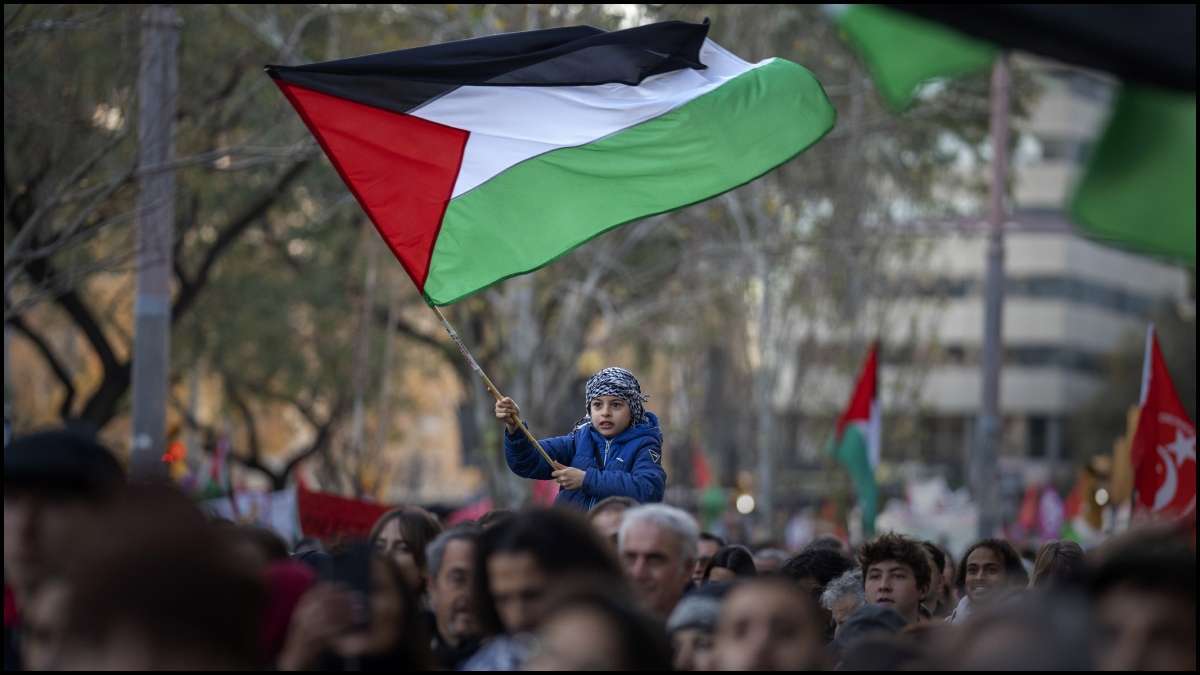
The ceasefire in Gaza is faltering as Israel and Hamas remain locked in disputes over the next phase of the agreement, leaving Palestinians to endure a harsh winter amid widespread destruction and dwindling hopes for meaningful progress.
Although the three-phase ceasefire plan — brokered by U.S. President Donald Trump, backed by Qatar, Turkey and Egypt, and endorsed by the United Nations Security Council — halted the heaviest fighting, both sides have been slow to advance the most difficult elements of the deal. Analysts say the agreement is now effectively on life support.
For residents in Gaza, the stalemate has dire consequences. Displaced families continue to live in tents among rubble, facing cold, rain and limited access to aid.
“Israel needs to let us live,” said Mohamed Hassouna, 44, who has taken shelter near Gaza City after his neighbourhood was destroyed. “They can be a country and we can be a country.”
At the heart of the impasse is the issue that has defined Israeli-Palestinian negotiations for decades: Palestinian statehood. While the ceasefire agreement briefly references a possible future pathway to self-determination, it stops far short of committing to a two-state solution. That lack of clarity has stalled progress on other core elements of the deal.
Former Israeli Major General Yitzhak Brik said Prime Minister Benjamin Netanyahu has little incentive to end the war, citing political considerations. “Disarming Hamas will not happen because there is no one who can enforce it,” he said during a recent panel discussion on Israel’s Channel 12.
One of the most contentious unresolved issues is the proposed International Stabilization Force (ISF) for Gaza — a multinational force envisioned to provide security, monitor the ceasefire and oversee the dismantling of Hamas’s military capabilities. Despite diplomatic efforts, no country has formally committed to leading or joining such a force.
U.S. Secretary of State Marco Rubio has expressed confidence that commitments will emerge, but so far, key players remain hesitant. Turkey has shown some willingness, but Israel has rejected any Turkish role, arguing Ankara is too close to Hamas. Other Muslim-majority countries, including Indonesia and Pakistan, have signalled openness, but fear that deploying forces without a clear transition to Palestinian statehood would amount to another occupation.
“The crucial question is whether the U.S. is willing to push Israel to accept a Palestinian state,” said H.A. Hellyer, a senior associate at the Royal United Services Institute in London. “Right now, that doesn’t appear to be happening.”
Hamas’s refusal to disarm presents another major obstacle. The group says it will only lay down arms once a sovereign Palestinian state is established — a stance that would require any international force to enforce disarmament through combat, not peacekeeping.
“If disarming Hamas is part of the mandate, nobody is going to join that force,” Hellyer said.
A frequently proposed compromise involves transferring temporary control of Gaza to the Palestinian Authority, but Netanyahu has rejected that option as well. Many analysts believe Israel prefers to keep Palestinian governance divided, reducing pressure to negotiate statehood.
Meanwhile, Hamas appears focused on survival and reasserting influence in Gaza as it pushes for phase two of the ceasefire. The group has returned all living Israeli hostages and the bodies of most others captured during the Oct. 7, 2023 attack, with one Israeli soldier’s remains still unreturned.
Security on the ground remains fragile. Israel now occupies more than half of Gaza, and the longer negotiations stall, the more permanent those positions risk becoming. Many Palestinians believe Israeli forces have no intention of withdrawing.
“This is not a force for stability — it’s a force of occupation,” said Ahmed Al-Kibriti, 36, who lives in a tent west of Gaza City.
Although large-scale bombardments have stopped, Palestinians say deadly strikes continue. Since the ceasefire began, more than 400 Palestinians have been killed, including civilians sheltering in schools. The Israeli military says it is investigating recent incidents.
The United Nations has repeatedly accused Israel of blocking humanitarian aid, including food, shelter and medical supplies — claims Israel denies. Aid agencies report that at least 16 Palestinians have died from cold and hypothermia in December alone.
Israeli officials blame Hamas for the deadlock, pointing to the remaining hostage. “We still don’t have our final hostage home,” said Shosha Bedrosian of Israel’s National Public Diplomacy Directorate.
Despite the grim outlook, diplomatic efforts continue. U.S., Qatari, Egyptian and Turkish officials are expected to meet in Miami, and a possible post-Christmas meeting between Trump and Netanyahu could prove decisive.
Former Jordanian foreign minister Marwan Muasher said Arab states see the Trump-backed plan as the only viable option to end the war, even if it falls short.
“It’s the only game in town,” Muasher said. “Not because it’s a great plan, but because it produced a ceasefire — and that makes engagement better than walking away.”