





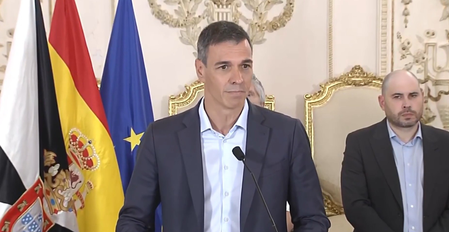
Spanish Prime Minister Pedro Sánchez travelled to the North African enclave of Ceuta on Friday after at least 34 migrants died during attempts to cross the border from Morocco, as tens of thousands of people entered the Spanish territory within 24 hours.
Ceuta regional president Juan Jesús Vivas said approximately 60,000 migrants crossed into the enclave by land and sea, with many swimming around border barriers to reach Spanish territory. He confirmed the death toll but did not provide further details on the circumstances of the fatalities.
Spanish authorities have launched a large-scale response, with Sánchez describing the mass crossings as a violation of Spain’s territorial sovereignty. He said the government was mobilizing all available resources and accelerating the repatriation process. Spain’s Interior Ministry said about 25,000 migrants had already been returned to Morocco by Friday.
Local officials described the situation as a humanitarian crisis, with thousands of migrants—including unaccompanied children—sleeping on streets and public spaces. According to local Civil Guard representatives, many of those who died drowned while attempting the crossing, while others were reportedly killed in a stampede near the Tarajal border area.
Moroccan security forces deployed water cannons and attempted to push crowds back from the border, while damaged vehicles were visible near areas where clashes occurred.
The surge follows a recent Spanish Supreme Court ruling limiting the immediate return of migrants arriving by sea. Sánchez said human trafficking networks exploited and misrepresented the ruling, encouraging migrants to attempt the crossing. However, migrant rights activists questioned whether the court decision was the main driver of the influx.
The crisis has prompted reactions across Europe. European Commission President Ursula von der Leyen called the scenes in Ceuta “unacceptable,” urging an end to dangerous crossings, stronger action against smuggling networks and faster migrant returns.
German Chancellor Friedrich Merz expressed support for Spain’s efforts to prevent undocumented migrants from reaching mainland Europe, while France said it was coordinating with Spanish and Moroccan authorities and could provide assistance through the EU’s border agency, Frontex. France also announced tighter border controls with Spain.
In Italy, Prime Minister Giorgia Meloni warned she could suspend aspects of the Schengen open-border agreement with Spain if necessary to protect Italy’s borders.
Ceuta’s regional government has called for additional police and military support, though Spain’s Interior Ministry said a national emergency declaration is not applicable to migration crises and instead pledged to provide more resources.