





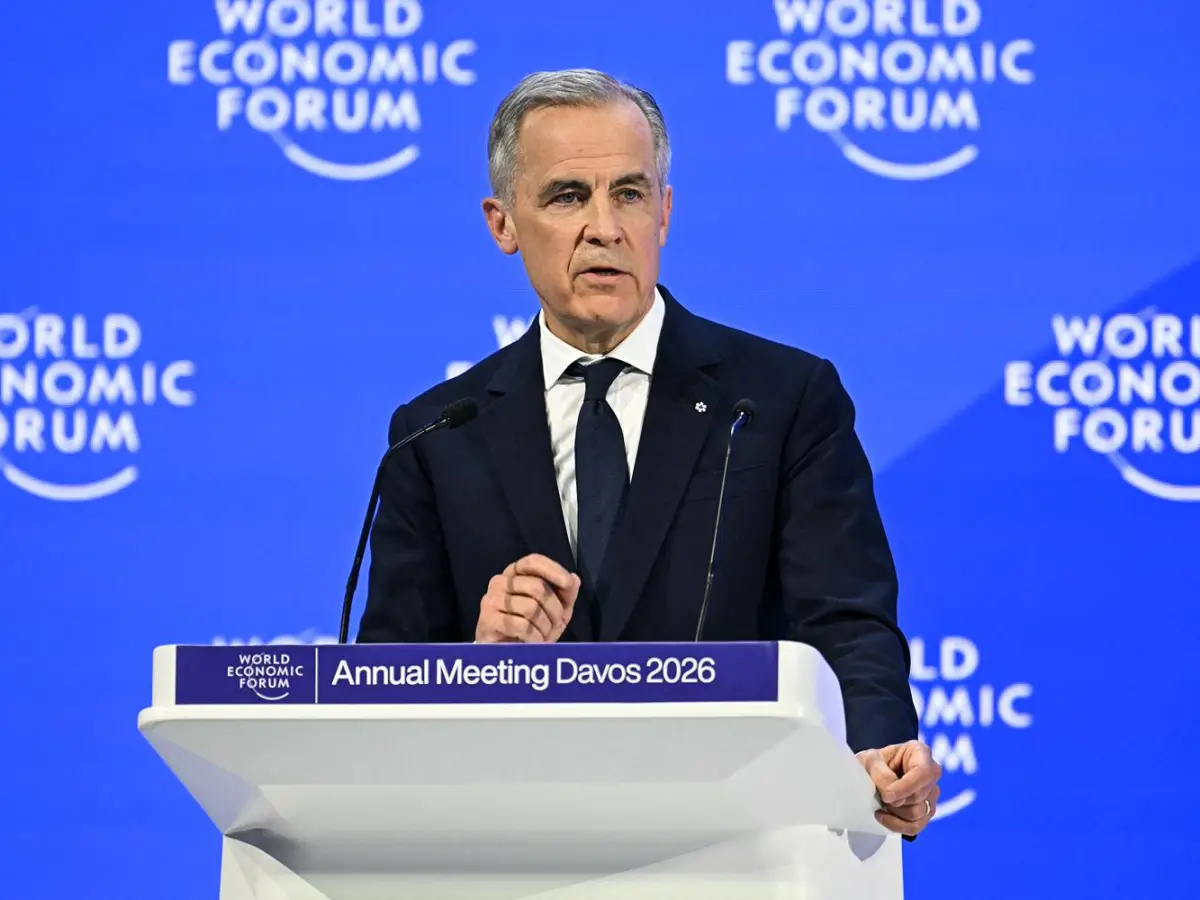
Canada’s evolving foreign policy strategy of building flexible partnerships beyond traditional alliances is already being put into practice at the United Nations, according to Canada’s ambassador to the UN, David Lametti.
Speaking about Prime Minister Mark Carney’s vision of “variable geometry,” Lametti said Canada is increasingly working with different groups of countries based on shared interests and specific global challenges rather than relying solely on long-standing alliances.
“We have set up a number of different kinds of relationships that work for specific issues,” Lametti said, adding that this reflects the approach Carney has outlined for addressing international challenges.
Carney first highlighted the concept during the World Economic Forum in Davos earlier this year, urging middle powers to work together to protect their interests in an increasingly competitive global landscape. He has since described “variable geometry” as a model built on dynamic, overlapping partnerships driven by common interests and, where possible, shared values instead of permanent institutional alliances.
The prime minister has argued that modern global challenges require broader cooperation. As examples, he has pointed to climate action involving European Union trade policies, technology standards developed by China and India, and environmental initiatives supported by countries such as Brazil.
Lametti said the United Nations has long operated in a similar way, with countries regularly forming issue-specific coalitions to build consensus across regions.
“At the UN, it happens all the time,” he said.
Canada has traditionally championed a rules-based international order, arguing that strong global institutions help smaller and middle-sized countries safeguard their security and economic interests.
According to Lametti, much of Canada’s work at the UN now centres on strengthening cooperation among middle powers to uphold international law and respond to emerging global crises.
He cited the multinational group addressing Haiti’s ongoing gang violence as one example. The coalition, co-led by Canada and the United States, also includes Central American nations affected by migration and cross-border crime.
Lametti also highlighted the Mountains Group, an informal coalition of countries including Canada, Australia, Iceland, Liechtenstein, New Zealand, Norway and Switzerland that advocates for human rights issues. He said the group’s role has grown in prominence as the United States has reduced its leadership on human rights initiatives at the UN.
Canada also works closely with Australia and New Zealand on issues ranging from women’s participation in peacekeeping operations to discussions surrounding the Israel-Hamas conflict.
“It’s something that allows us to pool work. We’re like-minded countries, we share values and we can work more efficiently,” Lametti said.
Another key partnership is the JUSCANZ group, which brings together countries including Canada, Japan, the United States, Australia, New Zealand, Türkiye and South Korea to coordinate positions on issues affecting developed economies outside the European Union.
Lametti said these partnerships are helping Canada advance priorities identified by the Carney government, including the responsible development of artificial intelligence, civilian protection during armed conflicts and preserving international rules-based trade.
He also pointed to Carney’s efforts to strengthen economic ties between the Comprehensive and Progressive Agreement for Trans-Pacific Partnership (CPTPP) and the European Union as another example of Canada’s evolving diplomatic strategy amid growing economic pressure from both the United States and China.
Speaking during a virtual discussion hosted by the NATO Association of Canada, Lametti added that rebuilding stronger relationships with both China and India remains an important Canadian objective.
“I don’t think we’re abandoning our traditional alliances so much as we are adding to them,” he said. “All of this is part of building onto relationships that we previously had.”