





Flights suspended at Riyadh airport amid reports of multiple blasts, while attacks on maritime vessels and diplomatic tensions raise fears of wider regional instability.
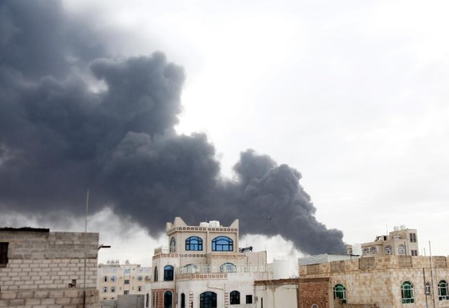
Several explosions were reported in Saudi Arabia’s capital, Riyadh, on Thursday, October 8, including a major blast at the city’s international airport that disrupted flight operations and prompted emergency evacuations.
The explosions occurred amid escalating tensions across the Middle East, as Yemen’s Iran-backed Houthi rebels continue targeting Saudi infrastructure, including airports and oil facilities.
However, authorities had not confirmed the cause of Thursday’s blasts, and no group had immediately claimed responsibility.
According to a witness who spoke on condition of anonymity, multiple explosions were heard across Riyadh, including a particularly powerful blast near the international airport.
Smoke was reportedly visible following the explosion, while firefighters and ambulance crews were dispatched to the area.
Passengers inside the airport were instructed to evacuate as departing flights were suspended. The witness described crowded terminals and said travellers were ordered to leave their checked luggage behind during the evacuation.
Flight-tracking service Flightradar24 indicated that aircraft movements at Riyadh airport had stopped shortly after noon local time, with no departures or arrivals recorded during the disruption.
The number of affected flights and the extent of any damage remained unclear.
Saudi authorities had not immediately responded to requests for information about the explosions.
The incident comes as Houthi attacks on Saudi infrastructure have heightened concerns about regional security and the potential consequences for international aviation and energy supplies.
Oil tanker attacked near Qatar as maritime security concerns grow
In a separate development, British military authorities reported that an oil tanker was struck by multiple projectiles in the Persian Gulf near Qatar late Wednesday.
The United Kingdom Maritime Trade Operations centre said the attack occurred north of Madinat ash Shamal, a city located on Qatar’s northern coast.
British officials confirmed that the incident resulted in multiple casualties but did not disclose the vessel’s identity or provide further details about those affected.
No organization immediately claimed responsibility for the attack, and Qatari authorities had not issued a public response.
The incident has added to concerns about maritime security in the Persian Gulf, a strategically important region for international oil and gas shipments.
Continued attacks on commercial vessels could further threaten shipping operations and disrupt energy markets already facing uncertainty from the regional conflict.
Britain downgrades diplomatic presence in east Jerusalem
Meanwhile, the United Kingdom has reached an agreement with Israel to reduce the status of its consulate in east Jerusalem following a diplomatic dispute over Israeli settlements in the occupied West Bank.
Under the arrangement, the British consulate will be redesignated as the U.K. Mission, with a smaller diplomatic team continuing limited operations.
The agreement follows an Israeli announcement last month that it intended to close the consulate in response to Britain’s decision to prohibit trade with Israeli settlements in the occupied West Bank.
Israeli Foreign Minister Gideon Saar confirmed that the facility would no longer operate as a consulate.
According to Israeli officials, approximately 20 British diplomats will leave Israel, while seven will remain to carry out restricted diplomatic activities.
British Foreign Secretary Ed Miliband rejected suggestions that the facility was closing entirely, emphasizing that the remaining diplomatic staff would continue working with Palestinians.
The British government also indicated that it did not intend to retaliate by expelling Israeli diplomats from London under the current agreement.
The development reflects growing diplomatic disagreements between Israel and several Western governments over settlement policies and the broader Israeli-Palestinian conflict.
Netanyahu accused of altering records related to October 7 attacks
Israeli Prime Minister Benjamin Netanyahu is facing fresh allegations concerning his government’s handling of the October 7, 2023, Hamas-led attacks.
Maj. Gen. Avi Gil, Netanyahu’s former military secretary, has accused the prime minister of attempting to alter official transcripts of telephone conversations conducted during the opening hours of the assault.
In an interview with the Israeli newspaper Israel Hayom, Gil alleged that Netanyahu’s chief of staff sought to modify records of conversations from the first hour of the attacks.
Gil suggested the alleged changes may have been intended to shift responsibility for security failures away from the prime minister and toward his advisers.
The former military secretary, who served between 2021 and 2024, said he reported the alleged attempt to Israel’s attorney general.
Gil also confirmed that a senior Egyptian intelligence official visited Israel shortly before the Hamas-led attacks.
However, he said he did not know whether the official had delivered a specific warning about the impending assault.
The allegations have emerged as Netanyahu prepares for Israel’s October 27 election.
His Likud party rejected the claims, characterizing Gil’s statements as part of an effort to remove Netanyahu from office.
Gil’s complete newspaper interview is expected to be published over the weekend, with a separate television interview also planned.
European Union prepares security support mission for Lebanon
Amid the widening regional crisis, the European Union is preparing a new mission to assist Lebanon’s military and security institutions.
EU foreign policy chief Kaja Kallas announced Thursday during a visit to Beirut that the proposed initiative would provide training and advisory support to Lebanese armed forces and security personnel.
Kallas said Lebanese authorities had formally requested the assistance and that EU foreign ministers were expected to consider establishing the mission on Monday.
The initiative is intended to strengthen Lebanon’s security capabilities but will not replace the United Nations Interim Force in Lebanon, commonly known as UNIFIL.
The peacekeeping mission’s mandate is scheduled to expire at the end of 2026, raising concerns about the future of international security oversight in southern Lebanon.
Lebanese authorities have previously advocated extending UNIFIL’s deployment, although approval from the United Nations Security Council appears increasingly uncertain.
Following the latest conflict between Israel and Hezbollah, Israeli forces continue to occupy significant portions of southern Lebanon.
Efforts to transfer control of those areas to the Lebanese military have made limited progress.
The possible withdrawal of UN peacekeepers has intensified concerns that Israel could prolong its military presence while Hezbollah militants might seek to exploit a potential security vacuum.
The proposed European mission is therefore being viewed as an effort to strengthen Lebanese institutions during a period of considerable uncertainty.
Together, the explosions in Riyadh, the tanker attack near Qatar, diplomatic tensions involving Israel and Britain, and growing security concerns in Lebanon underscore the increasingly fragile situation across the Middle East.
With military confrontations continuing and regional infrastructure facing potential threats, international attention remains focused on preventing further escalation and limiting the conflict’s impact on civilians, transportation networks and global energy supplies.