





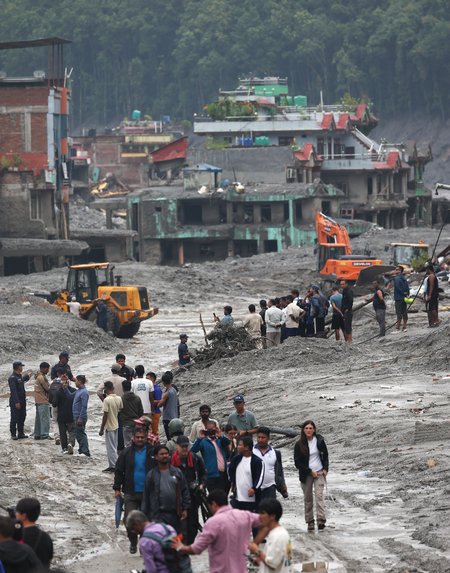
Climate change likely contributed to destabilizing the massive glacier collapse that triggered catastrophic flooding across parts of Nepal and Tibet last month, according to the first scientific study examining the disaster.
Researchers found unusually warm conditions in the period leading up to the collapse on Langtang Lirung mountain on August 26. A huge section of overhanging glacier and rock, covering roughly 200,000 square metres, broke away and plunged about 1,400 metres into the valley below. The collapse released an estimated 110 million cubic metres of snow and ice, setting off devastating flash floods downstream.
More than 1,300 people were killed in the disaster, while more than 5,000 remain missing. The impact of the collapsing ice and rock was so powerful that it registered as an earthquake. The avalanche liquefied large quantities of ice, creating a fast-moving torrent of freezing water, rock, ice and sediment that reportedly travelled downriver at speeds exceeding 110 miles per hour.
The flood swept through communities with little warning, destroying homes, settlements, roads, bridges and other infrastructure. Researchers described rock avalanches of this magnitude as extremely rare, estimating that an event of comparable size would normally occur only once every 1,000 to 10,000 years.
The study, conducted by researchers associated with World Weather Attribution and Imperial College London, did not attribute the disaster to a single weather event. Instead, scientists described it as a compound crisis in which several destabilizing factors had been intensified by decades of rising temperatures caused by greenhouse gas emissions.
Researchers said the long-term effects of global warming around the glacier provided clear indications of climate change’s influence. Unlike conventional attribution studies that examine how warming affects the probability or intensity of an individual heatwave, storm or rainfall event, the researchers assessed how changing climatic conditions may have gradually weakened the mountain environment before the collapse.
Climate scientist Dr. Friederike Otto of Imperial College London warned that warming in high-altitude regions is creating potentially severe consequences for communities downstream. She argued that disasters of this magnitude also demonstrate the limits of local adaptation when major mountain systems become increasingly unstable.
The researchers said the disaster highlights growing risks across the Himalayan region as rising temperatures affect glaciers, frozen ground and mountain slopes. They cautioned that while communities can strengthen preparedness and infrastructure, some extreme events may exceed the level of protection that adaptation measures alone can provide.
The study concluded that the Nepal-Tibet disaster illustrates how climate change can contribute to cascading hazards rather than simply individual extreme-weather events. Scientists said reducing greenhouse gas emissions remains critical to limiting further warming and the associated risks of destabilization in some of the world’s most vulnerable mountain regions.