





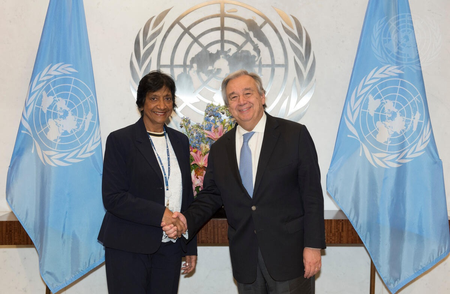
Norwegian Nobel Committee recognizes South African legal pioneer for decades of work defending human dignity, accountability and the rule of law
South African-born human rights advocate and International Court of Justice (ICJ) judge Navanethem (Navi) Pillay has been awarded the 2026 Nobel Peace Prize in recognition of her lifelong commitment to international justice, human rights and the protection of fundamental legal principles.
The Norwegian Nobel Committee announced the honour in Oslo on Friday, October 9, praising the 85-year-old jurist for her contributions to international law and her efforts to defend vulnerable communities against discrimination and injustice.
Committee chair Jørgen Watne Frydnes described Pillay as one of the most influential defenders of international legal principles, highlighting her career spanning the struggle against apartheid in South Africa and her involvement in significant international judicial proceedings.
Pillay, who was attending the Nuremberg Forum in Germany when the announcement was made, expressed gratitude for the recognition. The location held particular significance because the historic Nuremberg trials of Nazi war criminals helped establish important foundations for modern international criminal law.
The veteran jurist said she was honoured to receive the award while surrounded by colleagues and fellow advocates committed to protecting human rights.
Born in Durban, South Africa, to parents of Indian Tamil heritage, Pillay overcame racial and gender barriers during the apartheid era to establish herself as a pioneering legal professional.
In 1967, she became the first woman to establish a law practice in Natal. She subsequently made history as the first non-white woman appointed to South Africa’s High Court.
Her early legal career included defending Nelson Mandela and other individuals who challenged apartheid, establishing a foundation for decades of advocacy focused on equality, accountability and access to justice.
Pillay later served as the United Nations High Commissioner for Human Rights and held judicial positions in international courts, contributing to major cases involving allegations of war crimes, crimes against humanity and genocide.
As a judge at the International Court of Justice, she is currently involved in proceedings concerning allegations of genocide against Myanmar’s Rohingya Muslim minority.
The case examines the Myanmar military’s treatment of the Rohingya population following operations that forced hundreds of thousands of people to flee to Bangladesh and neighbouring countries. The military campaign involved allegations of widespread killings, sexual violence and other serious human rights violations.
Pillay indicated that she remains committed to seeing the proceedings through to their conclusion.
Her international work has also attracted controversy, particularly regarding the conflict between Israel and Hamas in Gaza.
Pillay previously chaired the United Nations Independent International Commission of Inquiry on the Occupied Palestinian Territory, which concluded in 2025 that Israel had committed genocide in Gaza during its military campaign following the Hamas-led attacks of October 7, 2023.
Israel rejected the commission’s findings, describing its report as unacceptable and politically motivated.
Pillay defended the inquiry’s conclusions, maintaining that legal assessments must be based on evidence, established legal principles and impartial interpretation.
Following Friday’s Nobel announcement, Israeli officials strongly criticized the decision.
Israel’s ambassador to the United Nations in Geneva, Daniel Meron, condemned the award and accused Pillay of promoting an agenda hostile to Israel. He also alleged that the commission’s work had distorted the circumstances surrounding the conflict.
The Norwegian Nobel Committee, however, emphasized Pillay’s broader contributions to international justice, particularly at a time when global institutions and legal frameworks are facing increasing pressure.
Frydnes warned that international law was confronting serious challenges as geopolitical power struggles increasingly threatened established legal principles and international accountability.
The committee presented Pillay’s career as an example of the importance of maintaining legal safeguards and protecting human dignity amid global conflict and political uncertainty.
South African President Cyril Ramaphosa congratulated Pillay, describing the Nobel recognition as a tribute to her courage, integrity and longstanding dedication to justice.
United Nations Secretary-General António Guterres also praised her achievements, emphasizing the importance of international law in preventing abuses of power and protecting human rights.
Pillay’s recognition comes amid renewed tensions between the United States and international judicial institutions. On the same day as the Nobel announcement, the Trump administration imposed additional sanctions targeting the International Criminal Court, where Pillay previously served as a judge.
The International Court of Justice, where Pillay currently serves, is the United Nations’ principal judicial body. Established in 1945, it resolves legal disputes between states and provides advisory opinions on international legal questions. Unlike the International Criminal Court, it does not prosecute individuals or impose criminal sentences.
Pillay’s Nobel Peace Prize follows the 2025 award to Venezuelan opposition leader María Corina Machado.
The Peace Prize is the fifth Nobel honour announced this week, following awards in medicine, physics, chemistry and literature. The Nobel Memorial Prize in Economic Sciences is scheduled to be announced on Monday.
For Pillay, the recognition marks another milestone in a career that began under apartheid and expanded to the highest levels of international justice.
Her achievement also highlights the contributions of the global Indian diaspora, with her Tamil heritage forming part of a personal history shaped by South Africa’s struggle for equality.
The 2026 Nobel Peace Prize recognizes not only Pillay’s individual accomplishments but also the enduring importance of international law, judicial independence and human rights in addressing some of the world’s most pressing conflicts.