




Prime Minister Mark Carney has welcomed the European Union’s proposal for a significantly deeper relationship with Canada, while making clear that Ottawa is not seeking full EU membership and that the final structure of any new alliance would have to be debated and voted on by Canada’s Parliament.
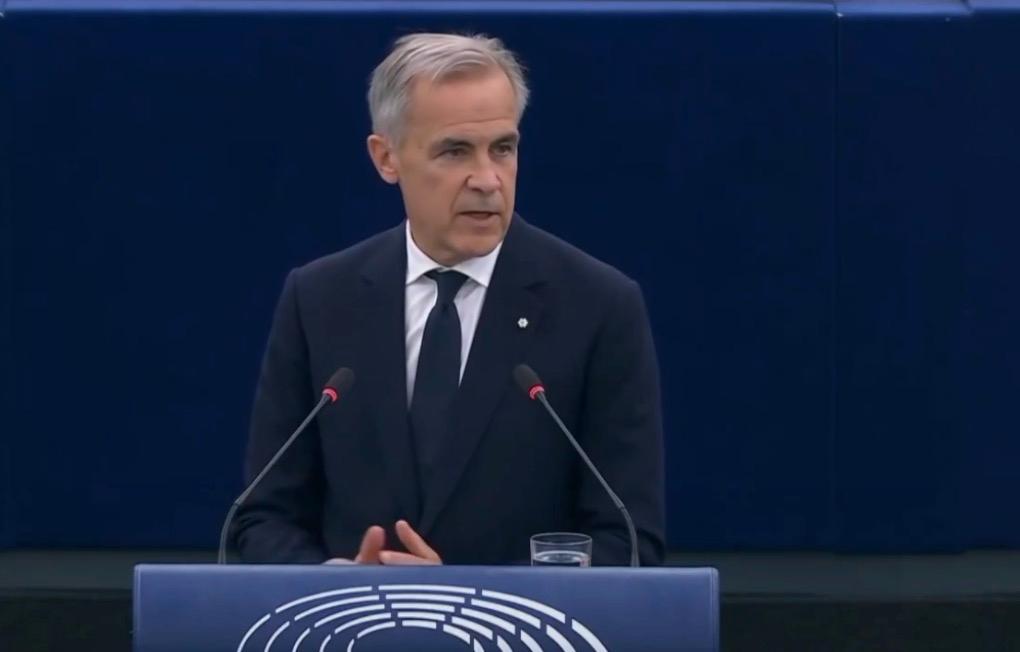
Addressing the European Parliament in Strasbourg on Thursday, Carney said Canada welcomed the ambition behind European Commission President Ursula von der Leyen’s proposal to open the door to Canada becoming the EU’s first “associate member.” However, Carney stopped short of adopting the term himself, emphasizing that the substance of the future relationship would matter more than what it is ultimately called.
Carney described the goal as a new and “unique alliance” that would go substantially beyond the Comprehensive Economic and Trade Agreement, or CETA, while respecting Canadian sovereignty. He argued that closer Canada-EU cooperation could strengthen both sides at a time of growing geopolitical and economic uncertainty.
The proposed partnership could encompass critical minerals, defence industrial capacity, artificial intelligence and computing, energy security, space, financial services and payment systems. Ottawa and Brussels are also examining closer digital trade and more secure infrastructure linking Canada and Europe.
Carney also highlighted the possibility of stronger people-to-people ties. The Prime Minister’s Office said deeper cooperation could provide young Canadians and Europeans with greater opportunities to live, work and study on either side of the Atlantic. However, no new mobility rights have yet been negotiated or approved.
Following his speech, Carney provided further clarity on how any agreement would be implemented in Canada. He said the proposed partnership would go through parliamentary debate, relevant committees and ultimately a vote in the House of Commons before its final structure could take effect. He also stressed that Canada is not pursuing full membership in the European Union, describing the proposed relationship as a different framework.
The European proposal itself also remains at an early stage. “Associate membership” is not currently an established category within the EU, and European officials have yet to define precisely what the status would entail. Any arrangement would require further negotiations and approval on the European side, with some EU diplomats expressing surprise that the idea had not previously been discussed with member states.
The proposal has also drawn a sharp response from U.S. President Donald Trump, who warned that Washington could impose significant tariffs on the European Union if he viewed the Canada initiative as hostile to the United States. European Commission officials rejected the suggestion that closer Canada-EU relations were directed against another country, saying the objective was to strengthen the two partners.
Asked about the U.S. reaction, Carney defended Canada’s ability to determine its own international relationships. He said no other country would dictate Canada’s culture, language or decisions about which international agreements it chooses to pursue.
In his European Parliament address, Carney framed the proposed alliance around economic resilience rather than the creation of a new geopolitical bloc competing with the United States or China. He argued that Canada and Europe should reduce their vulnerability to economic coercion by diversifying relationships and combining their complementary strengths.
Europe, Carney said, offers enormous market scale, research capacity, advanced manufacturing and an expanding defence industrial base. Canada, meanwhile, brings substantial energy resources, critical minerals, expertise in artificial intelligence, quantum technology and space, a major financial sector and strategic geography connecting the Atlantic, Pacific and Arctic.
Canada and the EU have already expanded their relationship beyond CETA. Canada became the first non-European country to participate in the EU’s SAFE defence initiative in February 2026, opening additional opportunities for Canadian defence companies to participate in European procurement.
The next major stage in negotiations is expected at the Canada-EU summit in Montreal on October 29 and 30. The meeting is expected to provide an opportunity for both sides to begin defining the practical structure of the proposed alliance and the areas where deeper integration could be pursued.
For now, Canada is neither joining the European Union nor becoming an EU associate member. Instead, Ottawa and Brussels are exploring a new category of partnership whose precise legal, economic and political structure remains to be negotiated. The significance of the initiative will ultimately depend on the market access, mobility arrangements, defence cooperation and other rights and obligations contained a final agreement.
Carney Welcomes Deeper Canada-EU Alliance, Says Final Deal Will Face Parliament Vote


- Advertisment -