





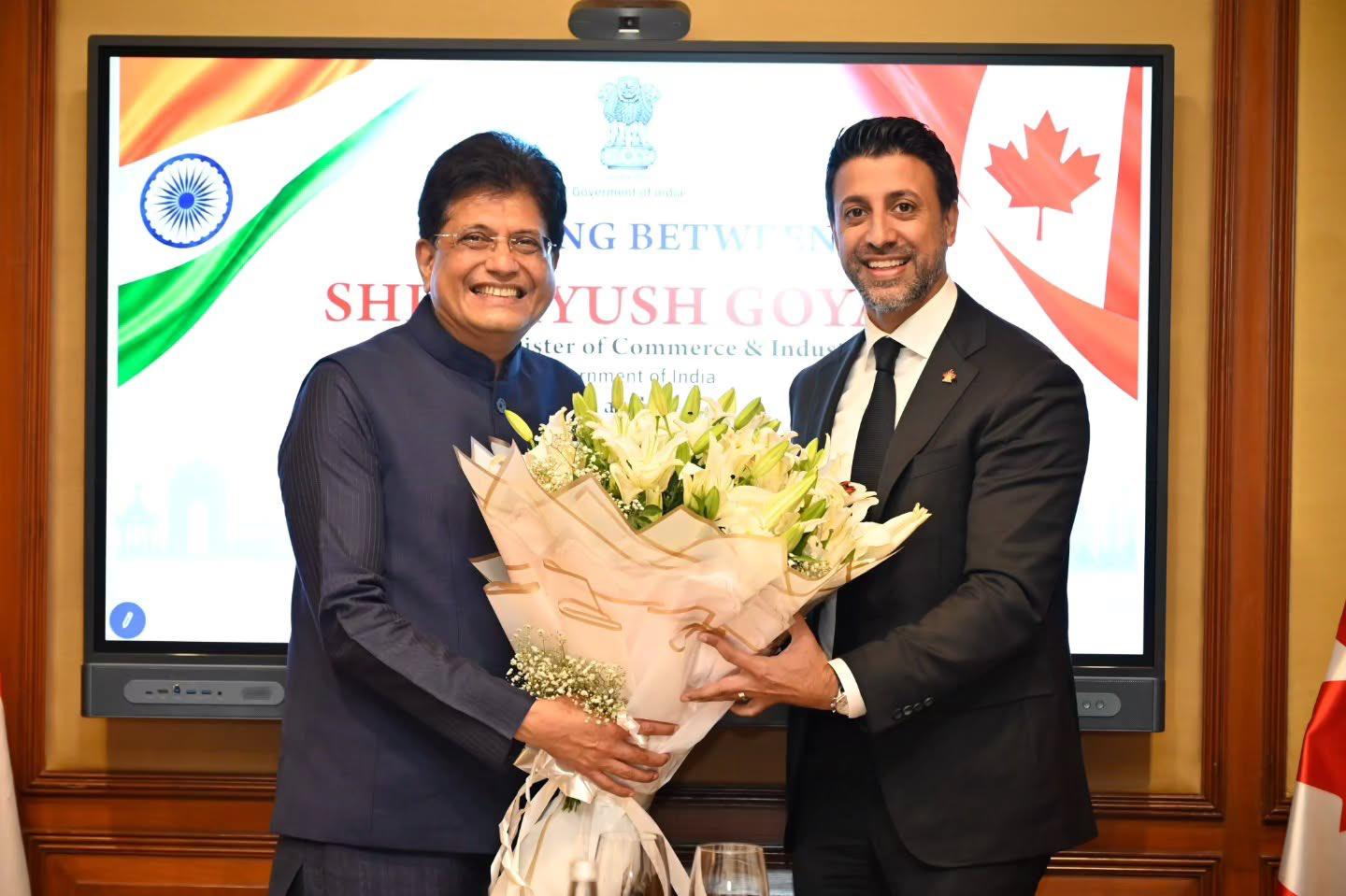
Canada is accelerating trade negotiations with India, the Association of Southeast Asian Nations and the Philippines as Ottawa seeks to expand its commercial relationships and increase exports to markets beyond the United States.
International Trade Minister Maninder Sidhu is visiting Mumbai today as part of efforts to strengthen Canada’s trade and investment relationship with India. During the visit, Sidhu is scheduled to meet Indian Commerce and Industry Minister Piyush Goyal, along with government officials and business representatives.
A key focus of the discussions will be negotiations toward a Canada-India Comprehensive Economic Partnership Agreement, or CEPA. Three rounds of negotiations have already been completed, with a fourth round taking place this week. Canada and India have expressed a shared objective of concluding the negotiations by the end of 2026.
Sidhu is also conducting business outreach during his Mumbai visit as Ottawa seeks to strengthen commercial ties with one of the world’s fastest-growing major economies. Canada has set a broader objective of doubling exports to markets outside the United States over the next decade.
India is expected to play a significant role in that diversification strategy. Canada and India are targeting $70 billion in annual two-way trade by 2030. In 2025, bilateral trade in goods and services stood at $30.4 billion, including $13.6 billion in merchandise trade.
Following his India visit, Sidhu is scheduled to travel to Manila for the 15th ASEAN Economic Ministers-Canada Consultation on September 21 and 22. Discussions with ASEAN countries will focus on advancing negotiations toward an ASEAN-Canada Free Trade Agreement.
Canada is simultaneously pursuing a separate free trade agreement with the Philippines. Sidhu is expected to meet Filipino counterparts in Manila to advance those negotiations while participating in the wider ASEAN meetings.
Canada’s trade relationship with Southeast Asia has expanded significantly. Bilateral merchandise trade between Canada and ASEAN reached $52.5 billion in 2025, an increase of 23.7 per cent from $42.4 billion in 2024. Canadian merchandise imports from ASEAN have increased by more than 100 per cent since 2020.
The Philippines was Canada’s sixth-largest merchandise export market within ASEAN in 2025. Two-way merchandise trade between the countries reached $3.4 billion that year, compared with $3.2 billion in 2024. Canadian exports to the Philippines totalled $1.1 billion, while imports from the country reached $2.3 billion.
The simultaneous negotiations with India, ASEAN and the Philippines form part of Canada’s broader push to diversify its international trade relationships. Ottawa is seeking to double Canadian exports to non-U.S. markets over the next decade while developing deeper economic ties with rapidly growing Indo-Pacific economies.
Progress over the coming months will depend on the outcome of the separate negotiations. The Canada-India CEPA, ASEAN-Canada free trade agreement and Canada-Philippines free trade agreement all remain under negotiation and have not yet been finalized.