





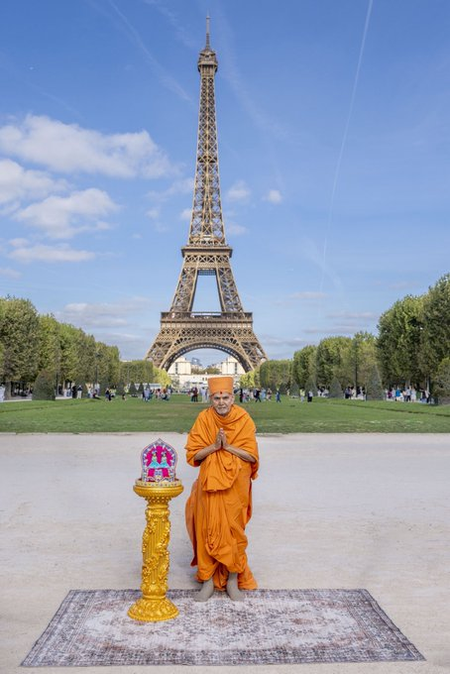
The Eiffel Tower has reopened after temporarily closing when employees walked off the job in protest over the treatment of female staff during a private visit by members of the Hindu organisation Bochasanwasi Akshar Purushottam Swaminarayan Sanstha, commonly known as BAPS.
The dispute began after BAPS representatives visited the Paris landmark over the weekend. According to the company operating the Eiffel Tower, the group had requested arrangements that would limit interactions with women.
The Societe d’Exploitation de la Tour Eiffel, or SETE, acknowledged that such conditions should not have been accepted.
Workers said female employees were instructed to leave certain posts, were replaced by male colleagues in some positions and were told not to enter or cross designated areas while the delegation was present.
The instructions prompted strong objections from employees, who argued that women had effectively been sidelined because of their sex. Staff subsequently went on strike, temporarily shutting one of France’s most recognizable landmarks.
The controversy is connected to religious practices followed by BAPS monks, known as sadhus. The monks observe strict celibacy and seek to avoid physical contact with women, being alone with women and certain forms of personal interaction with the opposite sex. Those restrictions do not apply to BAPS members generally.
Reports said the Eiffel Tower delegation included both monks and other members of the BAPS community.
BAPS Paris later apologized to anyone affected by the incident while saying that, to its knowledge, nobody had been denied access to the Eiffel Tower.
The incident nevertheless triggered criticism from senior French political figures, who argued that religious accommodations should not override the country’s commitment to equality between women and men.
Paris officials have also indicated that the circumstances surrounding the incident will be investigated.
What is BAPS?
BAPS is an international Hindu socio-spiritual organisation founded in India in 1907. It began expanding internationally during the 1960s and today operates a large network of temples and cultural centres around the world.
The organisation is involved in religious activities as well as community initiatives including disaster relief, medical camps, education and environmental programs.
BAPS says it has more than 1,000 temples worldwide, including more than 100 in the United States, with a presence across Europe, Africa and Asia. The organisation also operates a temple in Paris.
The Eiffel Tower controversy came shortly after Indian Prime Minister Narendra Modi virtually inaugurated the BAPS temple in Paris.
BAPS describes itself as apolitical and is not formally affiliated with an Indian political party. However, some researchers have pointed to its close relationship with Modi and his Bharatiya Janata Party-led government. Modi has participated in several major BAPS events, including the 2024 inauguration of its Hindu temple in Abu Dhabi.
Previous controversies
BAPS has faced legal disputes and allegations during its history.
In a 1966 Indian Supreme Court case, BAPS representatives unsuccessfully argued that the Swaminarayan sect constituted a religion distinct from Hinduism in a dispute involving legislation requiring Hindu temples to permit entry to Dalits.
Decades later, two former BAPS monks filed a complaint in 2013 containing sexual-assault allegations against senior figures in the organisation dating back to the 1970s. BAPS denied the allegations, and the complaint did not result in publicly reported criminal charges.
BAPS also faced a U.S. civil lawsuit beginning in 2021 in which Indian workers alleged exploitation and abusive working conditions during construction of its temple complex in Robbinsville, New Jersey.
The lawsuit alleged that workers recruited from India were paid extremely low wages and required to work long hours under restrictive conditions. BAPS disputed allegations of wrongdoing.
A U.S. federal investigation related to possible labour trafficking at the site was later closed without criminal charges. The workers’ civil litigation, however, has continued.
The Paris dispute has now placed renewed attention on BAPS and raised a broader debate in France over how religious accommodations should be balanced with workplace protections and the country’s principle of gender equality.