





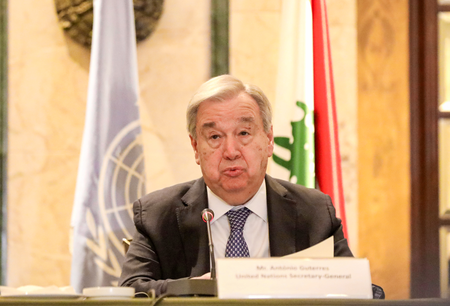
United Nations Secretary General Antonio Guterres has expressed concern over the renewed escalation in West Asia and urged all parties to immediately stop attacks, exercise maximum restraint, and refrain from any action that could further inflame an already volatile situation.
He urged all parties to fully abide by the ceasefires in Lebanon, Iran and Gaza, and avoid any steps that could undermine ongoing diplomatic efforts.
“The Secretary General is also deeply concerned by the decision by Israel to close crossings into Gaza. He reiterates his call for the immediate reopening of all crossings to ensure the rapid, safe and unhindered passage of humanitarian assistance at scale throughout Gaza,” Deputy Spokesperson for the Secretary General, Farhan Haq, said in a statement.
Guterres underscored that the exercise of navigational rights and freedoms, in accordance with international law, must be respected. He urged all parties to uphold their obligations under international law and take all feasible precautions to protect civilians.
“The Secretary General reiterates that there is no military solution to the conflicts in the Middle East. The only way forward is through dialogue and negotiations. He therefore urges all concerned parties to work towards diplomatic solutions that advance regional and international peace and security,” Haq said in the statement.
The UN chief’s statement comes amid ongoing tensions in West Asia following recent exchanges between Iran and Israel on Monday.
On Monday, the Israel Defence Forces (IDF) said that it had struck “several targets” at the petrochemical complex in Iran’s Mahshahr area.
Meanwhile, Iran’s Islamic Revolutionary Guard Corps (IRGC) said its aerospace forces on Monday morning targeted two “important and strategic” Israeli air bases in retaliation for Israel’s attacks earlier in the day against the Gulf country.
In a statement on its official news outlet, Sepah News, the IRGC said that it struck Israel’s Nevatim and Tel Nof airbases in response to Israel’s missile strikes on several radar sites in three Iranian locations.
The IRGC added that all its combat and operational units are ready to carry out operations on all fronts.
Explosions were heard in Tehran and in two other provinces early Monday, sources reported, quoting the media.
Citing local sources, the report said one explosion was heard west of Tehran, two in the central province of Isfahan, and one near Tabriz, the capital of the northwestern East Azarbaijan province.
Later in the day, Israeli Prime Minister Benjamin Netanyahu announced that the attack against Iran is currently “on hold,” but warned that Israel will respond forcefully if Iran resumes its attacks.
“At the moment, the fire is on hold because after … it (Iran) stopped attacking us,” Netanyahu said in his first televised statement more than 20 hours after Iran first launched missiles at Israel on Sunday night.
If Iran “makes the mistake of attacking us again, we will respond with force,” he added.
Netanyahu said he had ordered the military to strike military and economic targets across Iran on Monday, the media reported.
Meanwhile, Iran’s main military command, Khatam al-Anbiya Central Headquarters, announced the cessation of the Iranian armed forces’ operations against Israel, sources reported.
In a statement, the headquarters warned that any further Israeli “aggression and malicious acts,” including in southern Lebanon, would trigger a much more “severe and crushing” response.